viaLibri Blog
Ups and Downs as we move to the clouds.
Searching on viaLibri has been up and down for much of the day today, chiefly as a result of recently moving our data to a cloud server. A few technical issues have emerged during the migration, in several cases causing the site to go down for a while until we made some adjustments. Search is again up and running and we hope to keep it that way, but the issues are not completely resolved and there are a few sites that are still temporarily missing from our results. We will keep working on it until everything is fixed and results from all our search sites are back.
We are very sorry for these interruptions and apologise for any inconvenience they may have caused. Once we have completely recovered we expect you will resume your searches on a much improved viaLibri, in terms of both speed and reliability. In the meantime your patience is greatly appreciated.
-Jim
York Antiquarian Book Seminar 2018
 The York Antiquarian Book Seminar will take place again this September for the fifth year running. It is an excellent educational opportunity for anyone interested in becoming an antiquarian bookseller, or just wants to learn about the marketplace for old and rare books. Three full days of courses will “provide an opportunity for leading specialists to share their expertise and experience with booksellers and collectors in a comprehensive survey of the rare book market, both antiquarian and modern.”
We are strong supporters of this program and will, this year, be making our own contribution to the benefits of participating by giving to all YABS students a free one-year subscription to viaLibri Premium Services. (This is normally a $150 value).
For more information about YABS you can go to their website here: https://www.yabseminar.com/. You should also note that there are several organisations and individuals who are offering scholarships to cover the full £495 tuition fee. A list of these can also be found on the site.
Poll on proposed EU import rules for books and other cultural goods
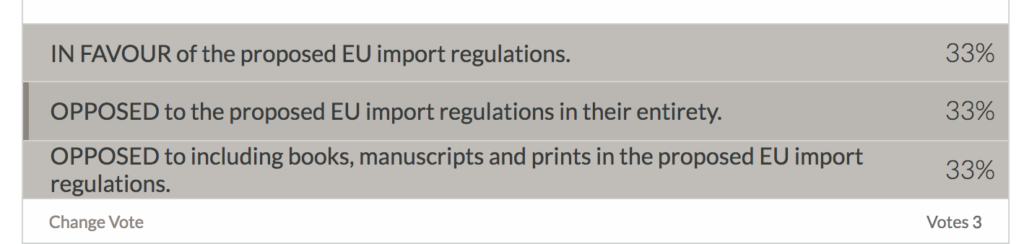
We have just added to the viaLibri blog an online poll on a question that should be of interest to all our users. It gives them an opportunity to record their opinions regarding European Union regulations, newly proposed, to control the importation of cultural goods, especially early books, manuscripts and prints.
We have also included on the polling page a number of links to documents and articles explaining the issues involved in this important piece of legislation. After you have cast your vote you will have an opportunity to leave your own comments and respond to the comments of others.
If you believe that these issues are important, as we do, then please share our links with your friends and any others who care about protecting the unrestricted international exchange of early books, manuscripts and prints.
New rules for importing early books and manuscripts into the EU – it will not be fun.
In my earlier post about the proposed EU import regulations I left out a detailed description of the ordeal you will have to go through when importing cultural goods. For most of the dealers I have heard from this is their primary concern. And with good reason. Although the details have not yet been spelled out completely, from what what I have read so far it seems possible that, for some at least, tranquilisers may be required.
After having now read the documentation several times this is what I understand:
For imports requiring an import licence (this would be incunabula and “rare manuscripts” over 250 years old) the “holder of the goods” must apply for an import licence from a “competent authority.” The “holder of the goods” is defined as the “person who is the owner of the goods or who has a similar “right of disposal” over them or who has physical control of them.” The competent authority, though not defined, will generally be a customs office that has special competence and training in the evaluation of cultural goods. These do not yet exist.
In simple cases this licence application is submitted to the competent customs office along with documentation proving that the goods were exported legally. The competent authority then has 30 days to examine the application and request any additional information or documentation it may feel it needs. Once the application is considered complete the competent authority has an additional 90 days to accept or reject it. When the application is accepted an import licence is issued. The goods may not be imported until the export licence is presented. Since provisions are made for the seizure of goods which enter the EU without a required licence, I assume that the items should not leave the export country until after the export licence has been issued.
The application must be made by a “holder of goods,” which means either ownership or physical possession. So if you are an EU resident and want to buy an incunable or early manuscript from an American seller you will first have to pay for your book, leave it in the US, apply for a licence and wait for the licence to be issued. Only then do you have the item shipped. It will have to be received by the right kind of customs office and examined there to make sure that the goods received correspond with the item described in the license. Only then will you be allowed to have your book.
I should note that Article 7 refers to restricting the number of customs offices that will be competent to release cultural goods. This suggests unavoidable difficulties if you happen to live someplace that is far from the right kind of customs office. If you are like me it is unlikely you will be comfortable having a valuable incunable or manuscript sent to a distant customs office to be examined and then sent back to you in the post. It is not mentioned at whose expense and risk such a shipment would be made.
The situation is only a bit simpler for books (or prints) that are not incunables. These are a separate category which require a self-generated importer statement instead of an import licence. But the problems are similar. The statement also needs to be presented to a “competent” customs office which will physically examine the book to determine that it corresponds with the statement you provided. It may also decide to conduct an “expertise,” which would presumably involve some additional delay. It is, again, unclear what the regulations anticipate happening in the situation where you live some distance from the right kind of customs office. Does the book get sent directly to customs and held there until your statement is received and your book examined? After that do you need to go to the customs office personally to recover your property, or will it be sent to you in the post?
None of these problems are meaningfully addressed in any of the documents I have read, which leads me to suspect that the people behind it all have yet to figure out a tolerable solution to them. I know I certainly haven’t.
Or is it possible that the regulations just assume that these steps will all be handled by customs brokers, and they just forgot to mention it? If that is the case, then the situation may be even worse than we imagine.
More thoughts on the new EU import regulations
I am still amazed by the audacity of the proposed EU import rules. Does anyone know of a comparable situation where administrative officials in one country are authorised to seize property on the basis of their understanding of the laws of another country?
Or over 100 countries?
With dozens of different languages?
Over several centuries?

