viaLibri Blog — 2018
Willcommen eBay.de | Bienvenue eBay.fr
We hope that German and French speaking bibliophiles will be pleased to learn that we have now added books from eBay.de and eBay.fr to our search results. Of course, you will not have to be German or French to add these in your search results. They will be available no matter what country you do your searching from.
We think this will make a significant addition to the already rich selection of continental European books that can be found using our site. Over 9 million items from eBay.de have been added along with another 7 million from eBay.fr. The listings on both eBays are updated frequently.
If you are among the many active users who record permanent wants and active keywords in our search manager then Libribot will soon be busy combing through all these fresh listings looking for things you might want. If you have any French or German titles among your desiderata then this would be an excellent time to add them to your wants.
Fröhliches Jagen! Bonne Chasse!
More Good News For eBay Fans
Regular eBay buyers (and we have learned that there are many of them) should be happy to hear that we have just expanded our coverage to include eBay sellers in Australia, Canada and Ireland. This will bring another 3 million books to the roughly 35 million eBay titles we brought online in July when we first began searching eBay.com (U.S.) and eBay.co.uk (U.K.).
Today’s expansion makes it possible to search in one place all 5 anglophone eBay sites. We know of no place else where that can be done. (Not to mention the other two dozen international sites we search.).
But it won’t end here. While our English-speaking customers are now fully served, we still have multiple European eBay sites that also beg to be searched. We plan to get those included as soon as possible.
And don’t forget that searching with viaLibri puts important tools and filters into your hands that are unavailable when searching on eBay itself. For example: do you sometimes search for early items only to be annoyed by a flood of modern reprints that you must endlessly scroll through instead. Click “No ISBNs” and “No PODs” and viaLibri will help you cull what you don’t really want. Or you can filter your results by the exact date range you want. Or sort by publication year. Interested only in books on Chicago from before 1872? Good luck trying that directly on eBay.
This should also be good news for viaLibri users who have recorded their permanent wants in our Wants Manager: Libribot will now also search daily for listings from the the newly added eBay sites. To take advantage you don’t have to do anything. Your latest matches will be emailed to you automatically.
But if your desiderata have not yet been added to your Wants Manager then this would be a great time to do so. Those 3 million new items mentioned above are now about to be matched against want lists for the very first time.
Get ’em while they’re hot.
viaLibri adds another new source for old books.
We are pleased to announce another addition to the wide range of sources we are search. Beginning today we are including over 2 million books from the new ChrislandsSearch website. All these items are for sale on independent online bookstores built and hosted by Chrislands.
In addition to now being searchable with our home page search engine, new items being added to the ChrislandsSearch group inventory will also soon be matched by our Libribot against all the want lists of our registered and Premium Services customers. If you have wants saved to our Wants Manager you may soon start receiving matches from hundreds of ChrislandsSearch booksellers.
Of course, if you don’t yet have any wants stored in your Wants Manager then we will have nothing exciting to report. So maybe this is finally the time for you to create a want list and discover the power of Libribot.

Charges filed in Carnegie library theft
Charges were filed today in the theft of rare books at the Carnegie Library in Pittsburgh, Pennsylvania. So far the most extensive public information about the crime and indictments has appeared int the Pittsburgh Post-Gazette under a headline reading:
Two men charged with stealing more than $8 million in rare books from Carnegie Library
Unfortunately, the Post-Gazette website is completely blocked to visitors in the European Union, making access to these latest details difficult for anyone on this side of the Atlantic to obtain. We have, however, been sent a PDF copy of the online version of the newspaper story and are thus able to provide it here.
PDF Version of Post-Gazette report on Carnegie Library thefts
Clicking the link above will open up a printer screen that will allow you to print the full story (14 pages). Click Cancel if you prefer to display a scrollable version of the same story.
Thoughts on Amazon’s $2630.52 Bodice Ripper.
A few days ago, under the online banner “Amazon’s Curious Case of the $2,630.52 Used Paperback,” the venerable New York Times reported with surprise on phenomena we are all too familiar with: second hand books for sale at absurd prices. The first book in question was a 2009 romance novel, for sale on Amazon, entitled “One Snowy Knight.” Having brought this information to the attention of David Streitfeld, the Times’ respected Amazon authority, the author then innocently asked “How many really sell at that price? Are they just hoping to snooker some poor soul?” She then alternatively wondered whether Russian hackers might not have taken up the manipulation of used book prices to keep themselves busy during their spare time.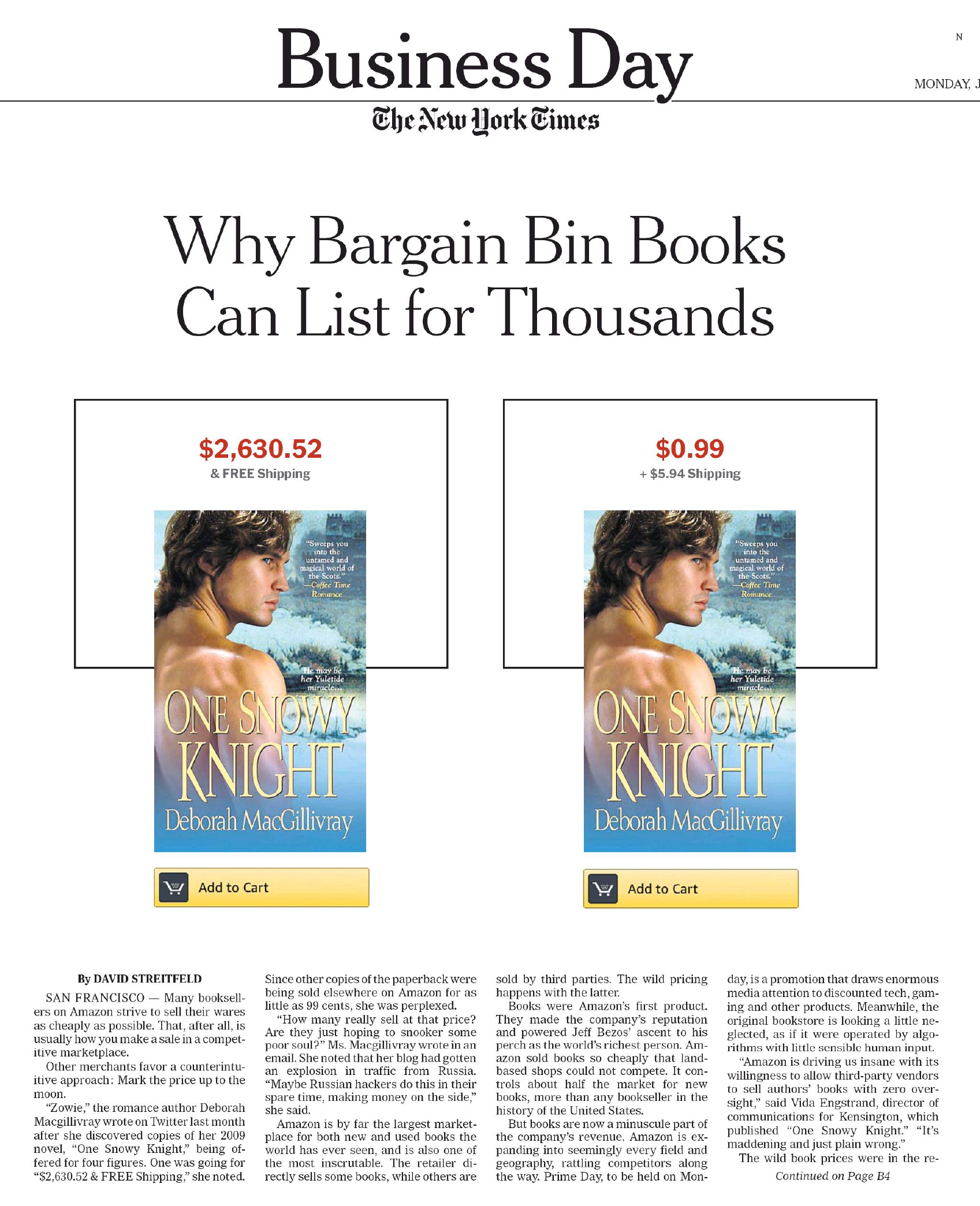
The answers to the questions are: 1-we will be astonished to ever see evidence that books with similarly absurd prices do actually sell, even on Amazon, and; 2- Russian hackers have better things to do, even when there are no elections available for them to subvert. The inflated prices reported in the the story are, almost certainly, the products of imperfect algorithms created to continually reprice products without any human intervention. Booksellers call it “robopricing,” a term of general contempt.
How this works and what it means for the future of second-hand bookselling is a dismal subject. I have already written a lengthy blogpost about it, which can be read HERE. I will refrain from going over it again. The New York Times article did, however, bring up a few interesting questions that I did not cover in my earlier post.
The focus of the Times piece was, of course, Amazon. Certainly the automated pricing tools are effective there, and it would be hard to argue that price adjustment is not a natural, even essential, part of retail sales. And when a price is obviously off the mark then it is probably due to a flawed algorithm rather than a scheme to fleece a naive and price-indifferent buyer.
But I am also wondering if there might not be more to it than that. Could there be other ways to benefit from putting a crazy price on a used book? In this case I couldn’t help but notice that the $2,630.52 bodice-ripper in question was out of print and the colourful tweet that illustrated the online version of the story made it a point to mention that a new reprint was scheduled for release in July. It can’t have been bad publicity for this news to appear on page B1 of the NYT when it did. Was it just a fortuitous coincidence? The author, Deborah MacGillivrary, is no ingénue in the art of influencing book sales on Amazon. Perhaps she has discovered some clever method for boosting the sales rank of a new book by drastically inflating the price of second-hand copies. If so, she is not letting us in on her secret.
However, someone from MacGillivrary’s publisher, Kensington, is also quoted in the story and prefers to point the finger of blame in a different direction. “Amazon is driving us insane with its willingness to allow third-party vendors to sell authors’ books with zero oversight… It’s maddening and just plain wrong.”
Streitfeld also sees culpability in the third-party sellers. He writes: “Amazon is by far the largest marketplace for both new and used books the world has ever seen… (Amazon) directly sells some books, while others are sold by third parties. The wild pricing happens with the latter.”
The problem with this is that third-parties are the only sellers of second-hand books on Amazon, which is only interested in selling new books on its own account. Without third-party sellers its book offerings would be limited to what is in print (or recently remaindered). At that point Amazon ceases to be “by far the largest marketplace for new and used books.” That status (which is quite arguable to begin with) would then belong to a metasearch site – like viaLibri for instance – where the number of independent sellers and second-hand book offerings substantially out-number those available from the Big A, even when its new titles are added in.
But this strays, of course, from the primary focus of the story, which gaped at an incomprehensible price attached to what should have been a cheap used paperback. It is not clear how this threatened the sanity of the featured publisher, who we presume is not also a third-party seller and does not traffic in used books.
We are also warned about “the wild pricing specialists, who sell both new and secondhand copies”. I have some experience in this particular world and this is not a category of bookseller I have yet encountered – at least not one who was active as a third party bookseller who sold both new and used copies with ‘wild’ prices. This explanation comes from Guru Hariharan, a former Amazon employee who now heads a company “which develops artificial intelligence technology for retailers and brands.” Referring to these wild pricing specialists he explains that “By making these books appear scarce, they are trying to justify the exorbitant price that they have set.” If Mr. Hanrahan has indeed discovered a method for making common books appear scarce then the prospects for his company would be rosy. I wouldn’t count on it. Internet search engines now provide a definitive measure of scarcity that is visible to anyone in the market place for old books. While it might be possible to make a scarce book appear common, I have not yet learned the secret for making a common book appear scarce. When I have mastered that bit of magic I will be sure to keep it to myself.
Unless I’m too late. The Russian hackers may already have started to work.

