viaLibri Blog
COVID-19 And The Rare Book Trade – ILAB Webinar
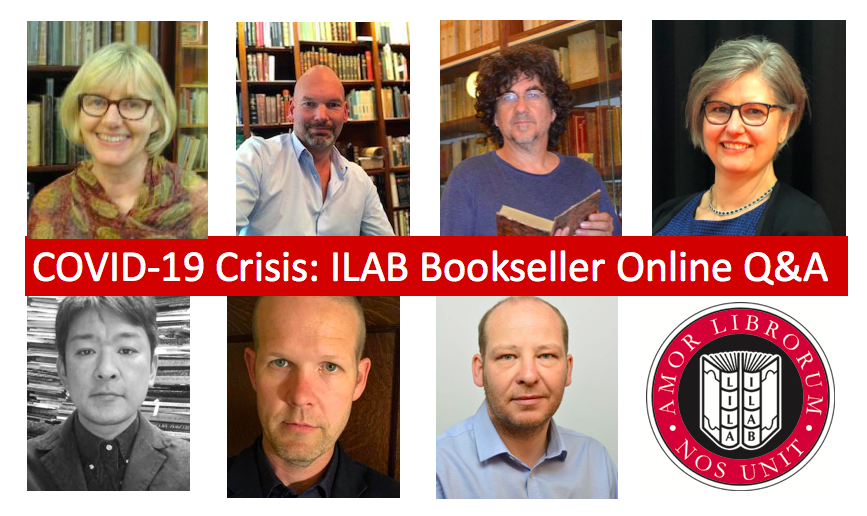 The ILAB has organised a ZOOM webinar for members of the worldwide book trade to discuss the COVID-19 pandemic and its impact on their business now and in the future
Lead by a panel of 7 prominent international booksellers, the event is scheduled for 2pm London time on Thursday April 9 and will be open to everyone via the internet conferencing platform “Zoom.”
Details about the program and how to participate will be found here:
https://ilab.org/articles/rare-book-trade-invited-ilab-webinar
Women and Work
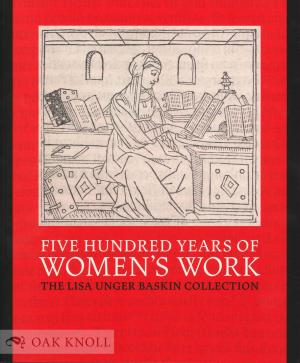
The Grolier Club recently hosted an important bibliographic exhibition entitled “Five Hundred Years of Women’s Work: The Lisa Unger Baskin Collection.” The collection focuses on early and rare books demonstrating the under-appreciated activities of working women in all areas and periods. Baskin gave a fascinating talk on her collection which can be viewed using the link above. It is well worth the time.
While the exhibition was taking place Baskin also lead several walking tours of 170 selected books from her collection that were on display. Those tours have now ended, but we can thank the Grolier club for also recording a video of one of them and making it available to all of us via Vimeo.
We can also highly recommend the illustrated catalogue that was published to accompany the exhibition, which had been held previously at its home in the David M. Rubenstein Library at Duke University. You can buy it here:
“Date added” is now a sorting option for search results
 A few weeks ago we quietly released an exciting new feature for viaLibri. You can now sort results by the date they were put up for sale. This is a change that a lot of people have asked for in the past, and we think it will be very useful for a lot of people.
Under the surface this has required quite a bit of work to get right, and it’s not without its limitations. The amount of information we get about a listing varies greatly depending on what site it’s listed on. For some sites we know exactly when an item was put up for sale, while for others we can pin it down to a 24 hour period. There are three sites (Amazon, Booklooker and Buchfreund) for which we don’t have enough information to even take a guess at when an item was added. As a result items from these sites will be shown right at the end of the results when you’re sorting by “date added”.
The results may also be a bit patchy if your search returns a large number of results. This is a result of how we fetch data from some websites. For example, we can fetch up to 50 results from antiquariat.de, but those will either be the most expensive 50 items that match your criteria, or the least expensive 50 items that match your criteria. We have no way of requesting the most recently added 50 items that match your criteria. So if your criteria are broad enough to match more than 50 items from antiquariat.de then they will be either the most or least expensive items. They will be shown in the order that they were put up for sale, but there’s no guarantee that they’re the most recent items put up for sale. As a result of this you’ll always get more useful results by using the most specific search criteria you can.
One further thing to note is that this new feature is only available when you start your search from our homepage. You won’t be able to pick “date added” as an option when reordering a search that’s already been completed.
New US Tariffs on Chinese Imports to include any books, old or new, made in China
According to a report we have just received from the ILAB [International League of Antiquarian Booksllers] the recently announced US tariffs on Chinese imports will apply to used, old and rare books as well new ones. This will even include books with only partial Chinese content and will apply to books imported from any country and produced at any period in time.
More details will be found on the ILAB website: https://ilab.org/articles/new-us-tariffs-chinese-goods-applicable-antiquarian-material
French language version is available here: https://ilab.org/fr/articles/nouveaux-tarifs-americains-sur-les-marchandises-chinoises
Do Book Collectors Need Rules?
 I recently listened with great interest to an online recording of the 2019 Malkin Lecture delivered last month at the Rare Books School in Virginia by Heather O’Donnell and Rebecca Romney. Its provocative title was: “The Right and Wrong Ways to Collect.” If you missed the live performance and haven’t yet caught the recorded version then I would strongly encourage you to click this link – bit.ly/2xNOE9z – and listen to what they had to say.
Their title captured my attention because it connected directly with the topic of another lecture I had, myself, presented at the University of London’s Senate House some five years earlier. For my lecture the title was: “Taste and Technique in Book Collecting – An Update for the Digital Age”. In my case, however, there were no recording devices present. I had instead intended to rework my original oral presentation into something more readable and then post it on our website where I knew that, if nothing else, our friend the Googlebot could be counted on to find and read it.
Of course, as often happens, action did not readily follow intention and the notes from my talk soon found their way, instead, into an archive folder on my laptop where they were eventually saved and forgotten. They would likely have stayed there, too, if listening to Heather and Rebecca had not brought them back to mind. I was thus nudged to update my own thoughts on the subject and put them into a form more suitable for appearing online. You can now find that here:
https://blog.vialibri.net/taste-and-technique-in-book-collecting-updated-for-the-digital-age/
Both lectures focused, in particular, on the ways in which the established “rules”and practices of book collecting have been altered, if not made completely irrelevant, by the internet and related technologies. Traditional collectors, and the booksellers who serve them, regularly bemoan the resulting loss of “standards” and complain of a general decline in book collecting as the inevitable result. I was happy to hear that Rebecca and Heather have seen a very different and more encouraging horizon. Theirs has been informed, in particular, by the numerous young collectors who have submitted entries to their annual Honey & Wax Book Collecting Prize. They give us a glimpse of a very positive future and I was pleased to hear about them.
Many of these young collectors have no interest in following in the footsteps of their predecessors. Nor should they. Some of their interests may seem incomprehensible to the collectors of my generation; they may have confessed to the prize judges that “I know I’m doing it wrong,” but what we learn from them is that, in fact, there is no such thing as “doing it wrong.”
My own lecture concluded with a similar message. It leaned heavily on the prescriptions of John Carter, the English bookseller who did more than anyone else of the previous century to explain and defend the “rules” of book collecting that guided my own generation of bibliophiles. Those are among the rules that are now being being tossed aside, or simply ignored, by a new generation – one that is mistakenly accused of having no interest in books. I personally find it fascinating to examine the origins and evolution of those rules, but it is even more exciting to think about the huge opportunities that are now opening up to this new wave of collectors who feel no need or interest in being told how or what to collect.
So if you are among the many who are skeptical and pessimistic about the future of book collecting I would like to direct you to the two links above. I hope they will cheer you up.

