viaLibri Blog — 2018
A better way to “Buy It Now” on eBay.
 We are pleased to announce that viaLibri now includes books from eBay as part of its search results. If you look in the “Where to Search” panel in the upper right hand corner of our home page search form you will see two check boxes for eBay.com and eBay.co.uk. When these have been ticked the old, rare and out-of-print “Buy It Now” book listings from those two sites will be added to all the items from all the other sites we already search. This means that over 30 million more items have now become searchable.
And there are more to come. We expect to start searching auctions on eBay in the near future and plan to expand to other international eBay sites as well.
But beyond just adding numbers to our search results we are also creating a better way to search eBay for books. You can now use viaLibri to search for books on eBay in ways that are not possible on any other site, including eBay itself. Once you have given us a try we are confident you will not want to go back to whatever you did before. Here are some of the things you will now be able to do, for the first time, when searching for books on eBay:
Authors: What could be more essential to the identity of a book than the name of its author? Nothing that we can think of. When a book is listed on eBay the author’s name is just another undifferentiated tidbit of information. Searching specifically by author is not possible. To overcome this limitation we have developed techniques to extract the author’s name from most eBay book descriptions . This means, for example, that if you wanted to search for books written by Martin Luther you could have results that were not also cluttered with books about him. You can also combine this with our exclusion feature to make sure that your search for books by Martin Luther did not also fill your results with books by or about Martin Luther King. This is something you cannot do when searching on eBay itself.
Publication Dates: The year in which a book was published is, of course, an essential element in determining its interest and value. One of the most useful tools that viaLibri offers to collectors is the ability for search for books within a specific date range and to sort results by date. If you are only interested in books on a subject before a certain date we can filter your results to eliminate the things you don’t want. This is something else you can’t currently do when searching on eBay directly.
Fuller descriptions for search results: Native search results on eBay show only a title, price and photo for the books that are returned. To see any details you need to click through to another page. Our results will in most cases show, in the results list, the notes or condition information provided by the seller. In this way, much needless clicking is avoided.
Bookseller easily identified: In addition to details about the book, our results list will also give the name of the seller who is offering that item, this helping to identify favoured sellers and eliminating what should be an unnecessary click.
First Editions: We have built our own eBay tool to find books which have been identified by their sellers as first editions. After testing the results we have found that we usually return significantly more eBay firsts when we search on viaLibri than when we search on eBay itself.
Signed copies: The same thing applies when we search for signed copies. In fact, with signed books we do even better than with first editions. In one case, for example, we turned up 3 signed copies of books by a particular author, while eBay had none, and did not even get an option for trying. If your collecting interests are focused on signed copies we should be able to help you find more of them.
Clipboard: The viaLibri clipboard is available for saving details of items you have found on eBay, along with items from any of the other sites we search. Even after the book is sold or withdrawn, the information about it will be stored indefinitely for future reference, or until you decide to delete it.
Exclusions: When searching on viaLibri you can specify words or phrases that help identify items that you want to exclude from your search results. eBay lets you use a single word in the title to select items for exclusion; viaLibri lets you use multiple words or phrases, and the exclusions can be applied specifically to the author, title or keyword fields. For example, this would be useful if you were searching for books about Charles Darwin but did not want books written by him. This can be easily done with viaLibri, but is impossible when searching directly on the eBay site itself.
No ISBN: A checkbox on the viaLibri search form lets you filter out books which have ISBN numbers. This is useful for identifying and excluding modern reprints of early editions when it is only the early editions that are of interest.
Translation: When an item is described in a foreign language you can use the viaLibri translation feature to translate the text into the language of your choice.
If you are only interested in looking for books on eBay then we feel quite confident that viaLibri is the best way for you to do it. All you need to do is go to the “Where to Search” panel and uncheck all the options except “eBay (UK)” and “eBay (US).” But why would you want to do that? We have over two dozen other boxes you can check that will lead you to books from many thousands of additional booksellers from around the world. eBay is an excellent place to look for books, but if it is the only place you have been looking so far, then I think you are in for a pleasant discovery.
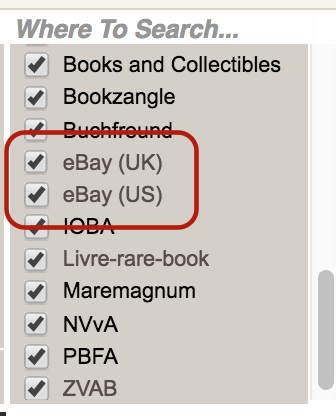
If you are, on the other hand, a long time hard-core eBay buyer then I think you will also be in for a pleasant surprise. Give it a try and see for yourself if we don’t make your hunt for books on eBay both easier and more productive.
Now We Have Amendments to the EU Cultural Goods Regulations. Manuscript Buyers Take Heed.
Back in March I posted here a series of blog posts concerning proposed EU regulations for the importation of “cultural goods.” The official objective of these regulations was to combat the looting and destruction of important cultural sites and to prevent the financing of terrorism through the trafficking of stolen cultural goods and artefacts. Early books and manuscripts were included among the objects that were targeted by these new rules even though no one I have heard from has yet seen evidence of terrorist finance activity in the rare book market. 
Needless to say, there was a great deal of concern in the antiquarian book market once the details of the proposed regulations became known and understood. The alarm, however, was somewhat relieved by the fact that the next stage in the process would allow for amendments to the initial proposal and that there was acknowledgement among at least some of the people involved that major changes needed to be made.
Well, changes are, indeed, afoot, but whether they improve or worsen the situation probably depends on the age and value of the objects you are interested in and whether they are most often books or manuscripts. For booklovers the extent of the burdens may, indeed, be a bit reduced. But for those who collect early manuscripts (and in some cases not so early) it looks like things will become even worse than originally proposed.
The deadline for making amendments has now passed. There are at least 381 of them, and I must confess to having skipped over a few. From our perspective, however, the most crucial amendments relate to the ANNEX at the end of the proposal. This is where they list all the various categories of cultural goods and define which items will be subject to import controls and which ones will not. There are nine separate proposed amendments, each with a different comprehensive set of rules. The major change being introduced now is the addition of valuation thresholds, although a variety of changes to the original age threshold of 250 years are also included.
The different amendments appear to be the work of the different political parties represented on the committee. All but one of them are proposed by only one, two or three MPs. For example, Amendment 413, sponsored by the 3 MPs from the European Peoples Party, adds a €50,000 minimum value threshold for most of the categories, including “old books, documents and publications of special interest ” that are more than 250 years old. This provides some relief for bibliophiles. However, this amendment leaves unchanged the original proposal as it regards incunabula and manuscripts over 250 years old .
But those amendments are probably all irrelevant. It is Amendment #408, offered by 6 members of the Progressive Alliance of Socialists and Democrats, which seems most likely, if any, to pass. This amendment makes several significant changes. With respect to books, the age threshold is reduced dramatically. Where the original proposal exempted books less than 250 years old, this amendment would reduce the age threshold to only 100 years. On the other hand, relief is offered by the introduction of a price threshold of €50,000 euros. Whether these two changes would raise or lower the number of books that would be covered is hard to say. Incunabula, which presumably includes incunable leaves, are still treated separately and will have no price threshold.
The greatest impact, however, will be on manuscripts. Previously only manuscripts over 250 years old were covered. Amendment #408 would reduce this to 50 years; and there is no compensating price threshold set. Any 51 year-old hand-written document would be subject to these rules regardless of value. There is an exception made for manuscripts belonging to their creators, but this is likely to be a very limited case.
It is extremely hard for me to find any sense here. The fear that terrorists are financing their activities through the looting and trafficking of old letters and hand-written documents seems obviously groundless. I cannot swear that such a thing has never happened and never will, but the extreme improbability of it balanced against the enormous amount of effort and expense involved in controlling it by these methods makes a complete travesty out of any claim that the authors of the regulations had any real concern for the proportionality that their regulations are supposed to respect. Much more could be said on this, but it seems unnecessary.
Another serious problem is created by an idea that appears for the first time in the amendments: minimum value thresholds. These are designed to significantly reduce the number of objects that are covered and thus limit the administrative burden placed on the importers and agencies involved. At first glance this idea makes sense and seems like an improvement over the original regulations, which were to be applied regardless of value. However, nothing is said here about how the these valuation thresholds will, in practice, be implemented. I can imagine only two possibilities.
The first possibility is that the importer would be required to submit an appraisal to prove that his goods fell below the minimum value threshold and were thus exempt from control. As far as I can see, there is no other requirement for a current appraisal as part of the import process. As a result, what we have here is the rather odd consequence that only the goods that are not subject to regulation will have to submit to the expense and delay of competent appraisal. And this assumes that the individual who wants to import something will have access to or know how to find someone with the necessary expertise.
The only alternative I can think of would be to have the importer simply declare a value himself, with or without the needed expertise. But of what use is that? If there are, in fact, terrorist manuscript dealers who are hoping to traffic their booty in the EU then I think they will be unlikely to declare the value of their goods to be in excess of the crucial threshold. In this context self-assessment is meaningless. Only the honest and innocent will be burdened by the rules.
As mentioned, there are 9 different amendments, each with its own age and value threshold. Some are worse than others. For example, Amendment 416 (drafted by MEPs from the Greens/European Free Alliance) does nothing except to change all the age thresholds from 250 years to 75 years. From my perspective Amendment 414 seems the least unreasonable, setting a minimum value threshold of €50,000 for books created before 1700 and for “rare manuscripts and incunabula before 1500 (sic).” But the lack of a reasonable and effective method for implementing the minimum value threshold is still a fatal flaw.
There is, however, one additional amendment (#417) that does seem reasonable and in more sensible alignment with the professed purpose of the proposed rules. Daniel Dalton, an MP from the UK, has proposed a second Annex which reads, simply, “List of Countries at Risk.” No details are provided with the Amendment text found on the European Commission site, but one can easily imagine what this might entail. There already exist restrictions for cultural goods imported from Iraq and Syria. Import regulation for those countries, and any others under similar terrorist threat, do make some sense. Whether on not this amendment can, in fact, accomplish that is not clear. Hopefully it is not too late in the process. As for the other amendments, I think they fall well short of correcting the deeply flawed regulations they attempted to repair.
Ups and Downs as we move to the clouds.
Searching on viaLibri has been up and down for much of the day today, chiefly as a result of recently moving our data to a cloud server. A few technical issues have emerged during the migration, in several cases causing the site to go down for a while until we made some adjustments. Search is again up and running and we hope to keep it that way, but the issues are not completely resolved and there are a few sites that are still temporarily missing from our results. We will keep working on it until everything is fixed and results from all our search sites are back.
We are very sorry for these interruptions and apologise for any inconvenience they may have caused. Once we have completely recovered we expect you will resume your searches on a much improved viaLibri, in terms of both speed and reliability. In the meantime your patience is greatly appreciated.
-Jim
York Antiquarian Book Seminar 2018
 The York Antiquarian Book Seminar will take place again this September for the fifth year running. It is an excellent educational opportunity for anyone interested in becoming an antiquarian bookseller, or just wants to learn about the marketplace for old and rare books. Three full days of courses will “provide an opportunity for leading specialists to share their expertise and experience with booksellers and collectors in a comprehensive survey of the rare book market, both antiquarian and modern.”
We are strong supporters of this program and will, this year, be making our own contribution to the benefits of participating by giving to all YABS students a free one-year subscription to viaLibri Premium Services. (This is normally a $150 value).
For more information about YABS you can go to their website here: https://www.yabseminar.com/. You should also note that there are several organisations and individuals who are offering scholarships to cover the full £495 tuition fee. A list of these can also be found on the site.
Poll on proposed EU import rules for books and other cultural goods
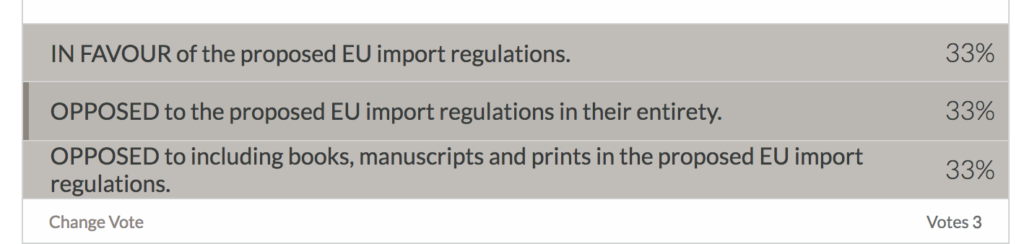
We have just added to the viaLibri blog an online poll on a question that should be of interest to all our users. It gives them an opportunity to record their opinions regarding European Union regulations, newly proposed, to control the importation of cultural goods, especially early books, manuscripts and prints.
We have also included on the polling page a number of links to documents and articles explaining the issues involved in this important piece of legislation. After you have cast your vote you will have an opportunity to leave your own comments and respond to the comments of others.
If you believe that these issues are important, as we do, then please share our links with your friends and any others who care about protecting the unrestricted international exchange of early books, manuscripts and prints.

